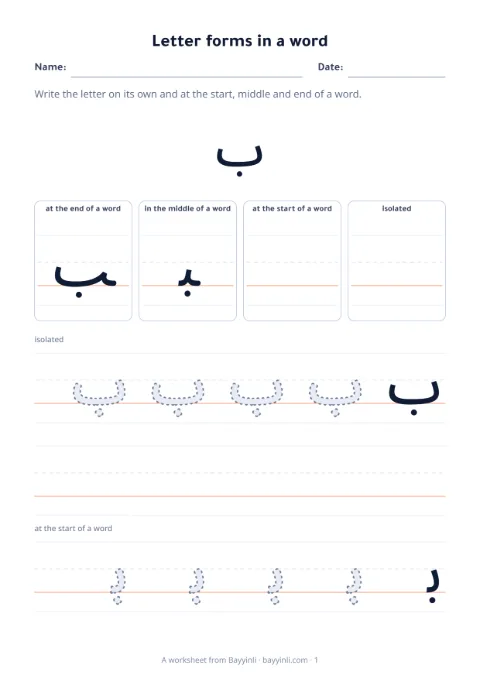
Arabic is written in a joined script: within a word, most letters connect to the next one with a short horizontal stroke along the baseline. That is why each letter has initial, medial and final forms.
ك + ت + ا + ب = كتاب
k + t + ā + b = kitāb (book)
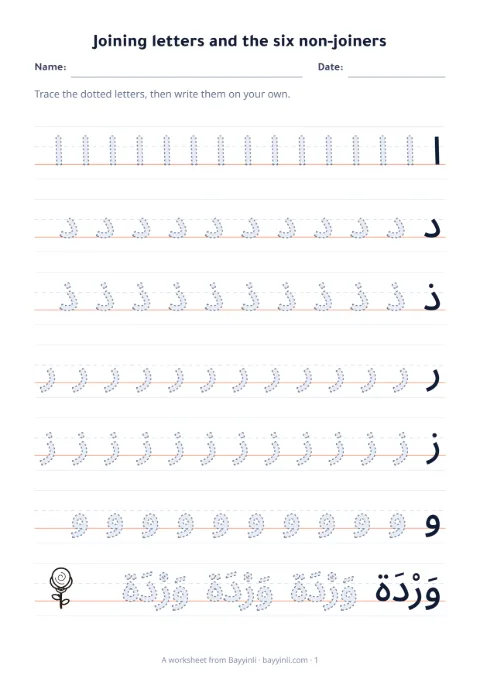
The six letters that never join forward
These letters connect to the letter before them, but never to the one after:
ا د ذ ر ز و
The next letter does not join the preceding one. Its shape depends on whether it joins the letter after it. Notice the gaps after dāl, rāʾ and wāw:
دَرَسَ — وَرْدَة — زَرَافَة — بَاب
Tāʾ marbūṭa ة and alif maqṣūra ى behave the same way because they only appear at the end of a word. A hamza standing alone ء joins neither side.
Lām-alif
When alif follows lām, the two are written together as a special ligature: لا, as in سَلَام (salām, peace) and لَاعِب (lāʿib, player).
How to teach joining
- Start with two joined letters from the same shape group, such as بب and تب, before longer words.
- Write a model word, showing where its letters join and where they remain separate, then ask the learner to write it.
- Compare the word written as separate letters with the joined word: ق ل م ← قلم.
- Use missing-letter exercises: learners see how a letter connects to its neighbours.
Try the missing letter exercise, and print word-writing practice from the Arabic worksheet generator.
Worked example
- ك ت ا بseparate letters
- كتابjoined in a word
- بَابa gap after alif
Joining and splitting a word
Choose a word, then join it step by step from its separate letters to the whole word, or split it back.