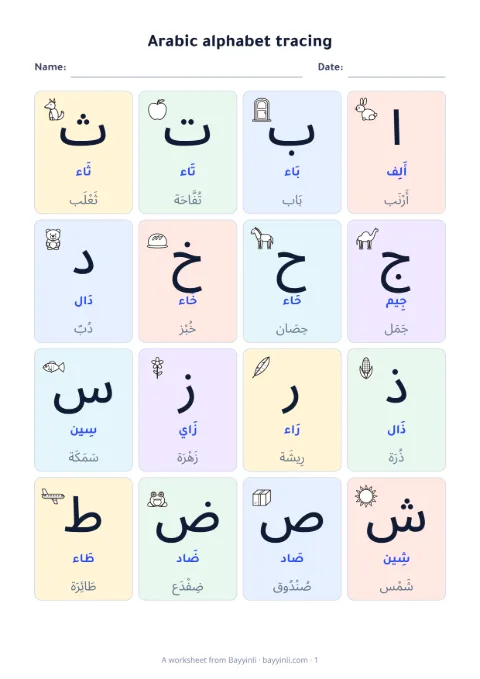
The Arabic alphabet has 28 letters and is written from right to left. There are no capital letters, but most letters change shape depending on where they appear in a word: on their own (isolated), at the start (initial), in the middle (medial) or at the end (final).
The table shows every letter in its four forms, with its usual name, an approximate English sound and an example word. Letters marked in red in the first column never join the letter that follows them.
| Letter | Name | Sound | Initial | Medial | Final | Example |
|---|---|---|---|---|---|---|
| ا | أَلِف | ā — long “a” (ā); also a seat for hamza | ا | ا | ا | أَرْنَب rabbit |
| ب | بَاء | b — “b” as in “book” | ب | ب | ب | بَاب door |
| ت | تَاء | t — “t” as in “ten” | ت | ت | ت | تُفَّاحَة apple |
| ث | ثَاء | th — “th” as in “think” | ث | ث | ث | ثَعْلَب fox |
| ج | جِيم | j — “j” as in “jam” | ج | ج | ج | جَمَل camel |
| ح | حَاء | ḥ — a breathy “h” from the throat | ح | ح | ح | حِصَان horse |
| خ | خَاء | kh — “kh” as in Scottish “loch” | خ | خ | خ | خُبْز bread |
| د | دَال | d — “d” as in “day” | د | د | د | دُبّ bear |
| ذ | ذَال | dh — “th” as in “this” | ذ | ذ | ذ | ذُرَة corn |
| ر | رَاء | r — a rolled “r” | ر | ر | ر | رِيشَة feather |
| ز | زَاي | z — “z” as in “zoo” | ز | ز | ز | زَهْرَة flower |
| س | سِين | s — “s” as in “sun” | س | س | س | سَمَكَة fish |
| ش | شِين | sh — “sh” as in “ship” | ش | ش | ش | شَمْس sun |
| ص | صَاد | ṣ — a heavy (emphatic) “s” | ص | ص | ص | صُنْدُوق box |
| ض | ضَاد | ḍ — a heavy (emphatic) “d” | ض | ض | ض | ضِفْدَع frog |
| ط | طَاء | ṭ — a heavy (emphatic) “t” | ط | ط | ط | طَائِرَة airplane |
| ظ | ظَاء | ẓ — a heavy “th” as in “this” | ظ | ظ | ظ | ظَرْف envelope |
| ع | عَيْن | ʿ — a voiced sound from deep in the throat | ع | ع | ع | عَيْن eye |
| غ | غَيْن | gh — a gargled “r”, close to the French “r” | غ | غ | غ | غَيْمَة cloud |
| ف | فَاء | f — “f” as in “fish” | ف | ف | ف | فِيل elephant |
| ق | قَاف | q — a deep “k” from the back of the throat | ق | ق | ق | قَمَر moon |
| ك | كَاف | k — “k” as in “kite” | ك | ك | ك | كِتَاب book |
| ل | لَام | l — “l” as in “lemon” | ل | ل | ل | لَيْمُون lemon |
| م | مِيم | m — “m” as in “moon” | م | م | م | مَوْز banana |
| ن | نُون | n — “n” as in “night” | ن | ن | ن | نَجْمَة star |
| ه | هَاء | h — “h” as in “hat” | ه | ه | ه | هَدِيَّة gift |
| و | وَاو | w / ū — “w” as in “water”, or long “u” (ū) | و | و | و | وَرْدَة rose |
| ي | يَاء | y / ī — “y” as in “yes”, or long “i” (ī) | ي | ي | ي | يَد hand |
Tips for beginners
- Dots tell similar letters apart. ب ت ث ن ي share almost the same body at the start and in the middle of a word; only the number and position of the dots differ.
- Six letters never join forward: ا د ذ ر ز و. They connect to the letter before them only. The next letter does not join the preceding one. Its shape depends on whether it joins the letter after it.
- Medial forms are usually shorter but keep their distinctive part, as in سـ ـسـ and عـ ـعـ ـع.
- Tāʾ marbūṭa ة only appears at the end of a word. It sounds like “t” when the word continues and like a soft “h” at a pause.
- Hamza ء is a glottal stop. It sits on alif, wāw or yāʾ, or stands alone, and is not counted among the 28 letters in the usual order.
In which order should you learn the letters?
Many teachers group letters by shape rather than alphabetical order: once a learner can write one body, adding dots gives several letters at once. Common groups are ب ت ث, ج ح خ, د ذ, ر ز, س ش, ص ض, ط ظ, ع غ and ف ق.
Transliterations in the table are approximate. Sounds such as ح, ع and the “heavy” letters ص ض ط ظ have no exact English equivalent and are best learned by listening to a teacher.
Practise each letter in its four forms with the Arabic alphabet tracing exercise, then test yourself with letter forms.
Worked example
- بisolated
- بat the start of a word
- بin the middle of a word
- بat the end of a word