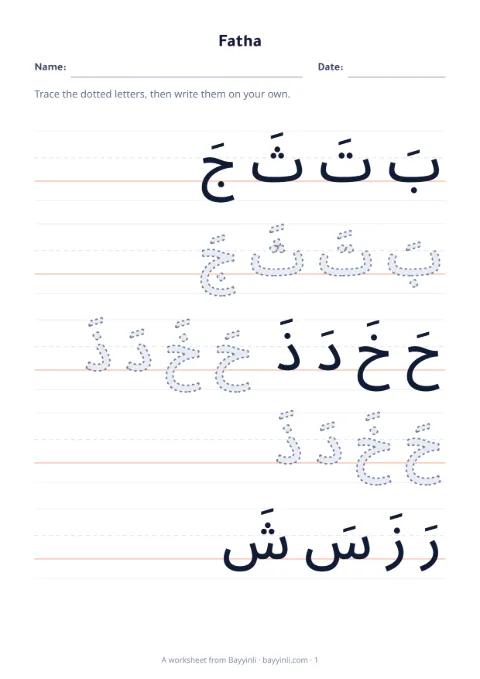
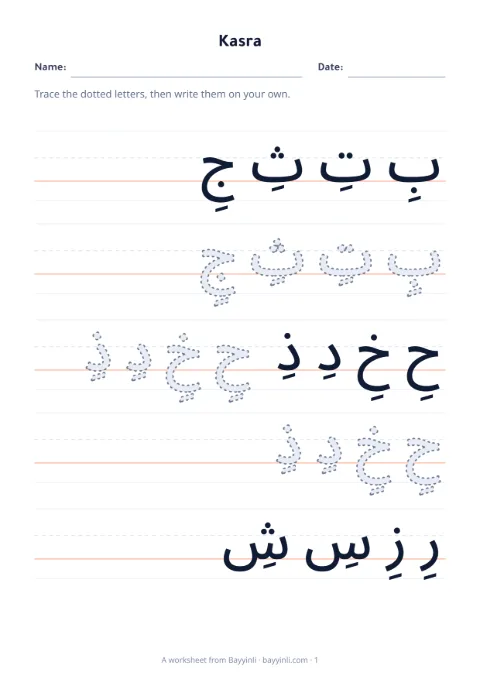
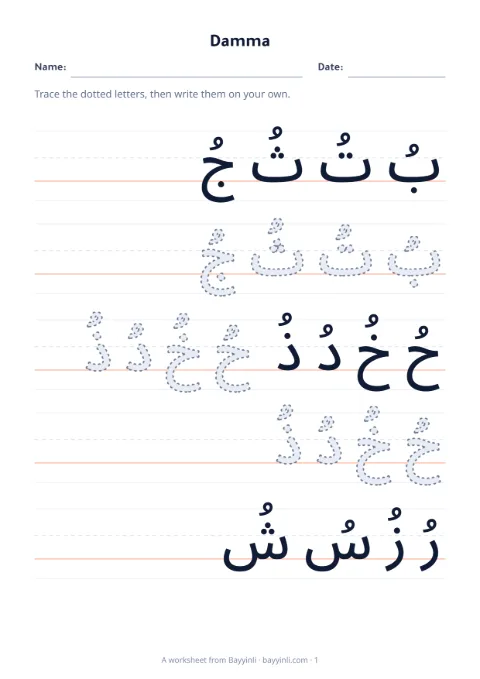
Harakat are small marks written above or below a letter to show how it is pronounced. They appear in children’s books, beginners’ texts and anywhere a misreading must be avoided. Newspapers and most adult books leave them out, and readers rely on their knowledge of the language.
| Mark | Name | With bāʾ | Reads | |
|---|---|---|---|---|
| ـَ | Fatha فَتْحَة | بَ | ba | A small slanted stroke above the letter. It adds a short “a”. |
| ـُ | Damma ضَمَّة | بُ | bu | A small wāw-shaped mark above the letter. It adds a short “u”. |
| ـِ | Kasra كَسْرَة | بِ | bi | A small slanted stroke below the letter. It adds a short “i”. |
| ـْ | Sukun سُكُون | بْ | b | A small circle above the letter. The letter has no vowel after it. |
| ـّ | Shadda شَدَّة | بَّ | bba | A small “w”-like mark. The letter is doubled (held longer). |
| ـً | Tanwin fath تَنْوِين الفَتْح | بً | ban | Two fathas at the end of a word, read “-an” in connected speech. |
| ـٌ | Tanwin damm تَنْوِين الضَّمّ | بٌ | bun | Two dammas at the end of a word, read “-un” in connected speech. |
| ـٍ | Tanwin kasr تَنْوِين الكَسْر | بٍ | bin | Two kasras at the end of a word, read “-in” in connected speech. |
Short vowels: fatha, damma and kasra
These three marks are the short vowels of Arabic. Compare بَ (ba), بُ (bu) and بِ (bi), then the same root in three words:
كَتَبَ — كُتُب — كِتَاب
kataba (he wrote), kutub (books), kitāb (book).
Sukun and shadda
Sukun marks a consonant with no following vowel, as on the lām in قَلْب (qalb, heart). Shadda doubles a consonant: it is pronounced once without a vowel and once with one, as in دَرَّسَ (darrasa, he taught). The vowel of the second letter is written with the shadda.
Tanwin
Tanwin is a doubled vowel at the end of a noun, read with an extra “n” that is not written as a letter: كِتَابٌ (kitābun), كِتَابًا (kitāban), كِتَابٍ (kitābin). An alif is usually added after tanwin fath. The tanwin lesson shows how to tell it from a single vowel.
Long vowels
The letters ا و ي lengthen the matching short vowel: بَا (bā), بُو (bū), بِي (bī). Hearing the difference between short and long vowels is one of the first steps to reading accurately.
Practise telling the marks apart with the Arabic vowel exercises, or print a vowel worksheet from the worksheet generator.
Worked example
- كَFatha
- كِKasra
- كُDamma