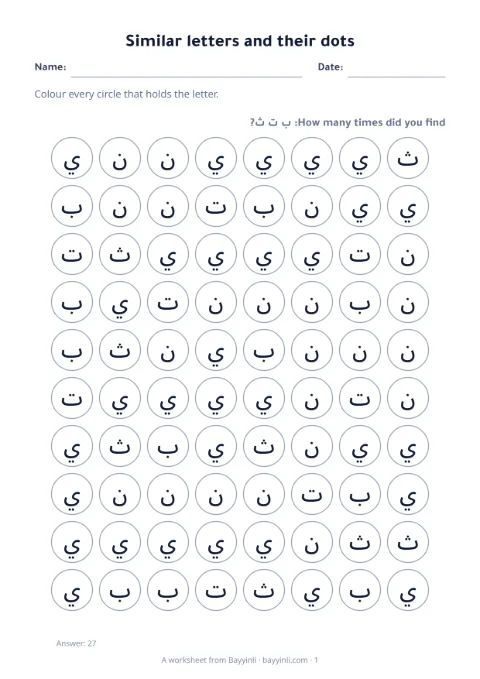
Many Arabic letters are built on the same body and are told apart only by their dots: how many there are, and whether they sit above or below the letter. Group the similar letters, then compare how many dots they have and where they sit.
The families
- ب ت ث: one dot below, two dots above, three dots above. At the start or in the middle of a word, ن (one dot above) and ي (two dots below) have the same small tooth: بـ تـ ثـ نـ يـ.
- ج ح خ: one dot inside the curve, no dot, one dot above.
- د ذ and ر ز: no dot, or one dot above.
- س ش: no dots, or three dots above.
- ص ض, ط ظ and ع غ: no dot, or one dot above.
- ف ق: one dot above, or two dots above. At the end of a word, ق also has a deeper, rounder tail than ف.
Read the dots first
Before naming a letter, ask two questions: how many dots, and above or below? In تُفَّاحَة (apple) the first letter has two dots above, so it is tāʾ, not bāʾ or nūn. In ثَعْلَب (fox) it has three dots above: thāʾ.
When writing, finish the body of the whole word first, then add the dots letter by letter. Dots added in the wrong place change the letter, and often the word.
Worked example
- بone dot below
- تtwo dots above
- ثthree dots above
- نone dot above
- يtwo dots below