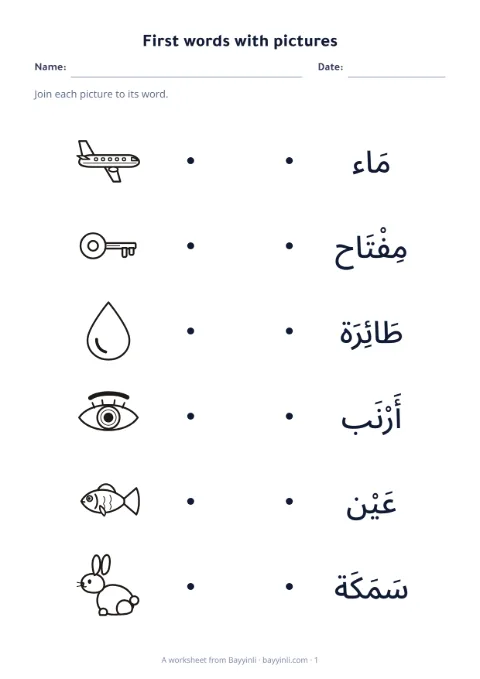
Once the letters, their joined forms and the marks are familiar, they come together in words, and words in short sentences. Reading a word is putting together what earlier lessons covered: its letters, how they join, and the vowel on each one.
Reading a word
Read from right to left, one syllable at a time: a letter with its vowel, plus a following letter with sukun or a lengthening letter. قَلَم is “qa-lam” (pencil), كِتَاب is “ki-tāb” (book), نَجْمَة is “naj-ma” (star). Then read the whole word without stopping.
First sentences
Many first sentences have no verb: “this is …” or “the … is …”.
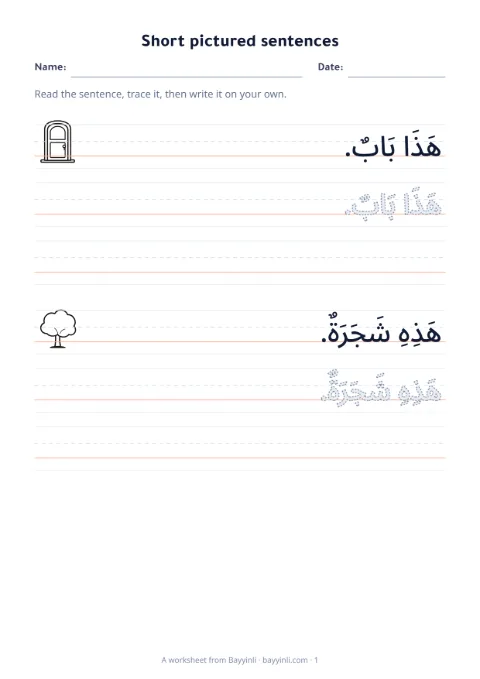
هَذَا بَابٌ. — الشَّمْسُ كَبِيرَةٌ.
This is a door. — The sun is big.
The double mark at the end of بَابٌ and كَبِيرَةٌ is tanwin: read “-un”, with an “n” that is not written as a letter. هَذَا is said “hādhā”: the long “ā” after the hāʾ is usually not written.
Understanding, not only decoding
Ask a question after each sentence: which picture matches it, or which word completes it. A learner who can answer has read the sentence, not only sounded it out.
Worked example
- هَذَا بَابٌ.This is a door.
- الشَّمْسُ كَبِيرَةٌ.The sun is big.