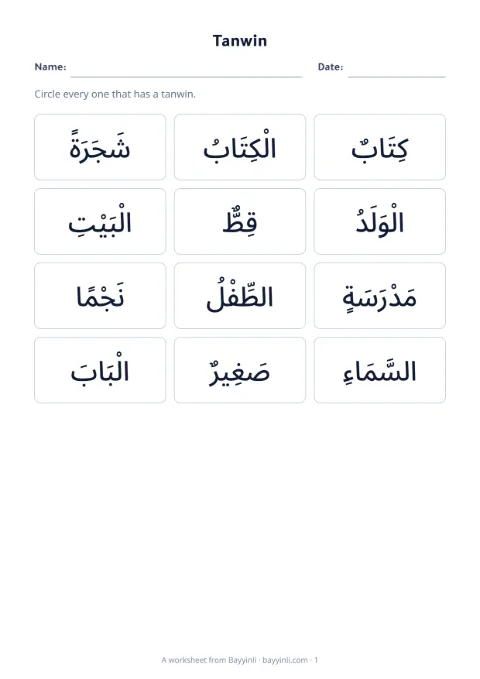
Tanwin is a doubled vowel sign at the end of a word. In connected speech, when you read on without stopping, it is read as the vowel followed by an n that is not written as a letter. There are three kinds, one for each short vowel.
The three signs
Tanwin damm ٌ is two dammas, tanwin fath ً two fathas and tanwin kasr ٍ two kasras under the letter. In connected speech they give -un, -an and -in: كِتَابٌ (kitābun, a book), كِتَابًا (kitāban), كِتَابٍ (kitābin).
Tanwin or a single vowel?
Look at the sign itself: one damma ُ or two ٌ, one fatha or two, one kasra or two. A word with ال never takes tanwin, so it ends with a single vowel: الْكِتَابُ (al-kitābu, the book), الْبَابَ, الْبَيْتِ.
The alif after tanwin fath
Tanwin fath is usually written with an extra alif at the end: كِتَابًا, حَلِيبًا. After ة no alif is added: شَجَرَةً. This lesson is about recognising the written sign; how a word is said when you stop on it is a separate topic.
In a sentence, look at the word you are asked about: in هَذَا كِتَابٌ it ends with tanwin damm, in قَرَأْتُ كِتَابًا with tanwin fath and in نَظَرْتُ فِي كِتَابٍ with tanwin kasr. The ending a word takes depends on its place in the sentence; in this lesson you only read the sign and name it.
Worked example
- كِتَابٌTanwin damm
- كِتَابًاTanwin fath
- كِتَابٍTanwin kasr
- الْكِتَابُwith ال: one damma