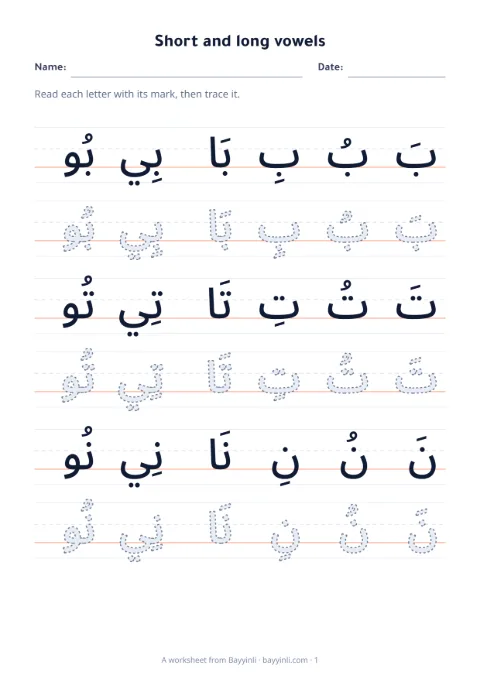
Arabic has three short vowels, written as marks (fatha, kasra and damma), and three long vowels, written as letters. A long vowel is the matching short vowel followed by a letter of lengthening: alif after fatha, yāʾ after kasra, wāw after damma.
| Short | Long | How it is written |
|---|---|---|
| بَ | بَا | fatha + alif: “ā” |
| بِ | بِي | kasra + yāʾ: “ī” |
| بُ | بُو | damma + wāw: “ū” |
Seeing the difference
In بَ the fatha gives the short sound; in بَا we add an alif to lengthen it. Not every vowelled letter is followed by a letter of lengthening: another letter of the word may come next, as in بَتَرَ (he cut off). In words: بَاب (door) and سَاعَة (watch) have a long “ā”, فِيل (elephant) and رِيشَة (feather) a long “ī”, صُنْدُوق (box) a long “ū”.
A long vowel is held for about twice as long as a short one. This page shows the written difference; say the pairs aloud with a teacher to hear it.
When wāw and yāʾ are long vowels
Wāw is a long vowel when it has no vowel of its own and the letter before it has a damma, as in صُنْدُوق; yāʾ is a long vowel when it has no vowel of its own and the letter before it has a kasra, as in فِيل. In وَرْدَة the wāw has its own vowel, and in بَيْت (house) the yāʾ has no vowel but follows a fatha (“ay”), so neither is a long vowel in these examples.
Worked example
- بَshort
- بَاlong
- بِshort
- بِيlong
- بُshort
- بُوlong